OSINT and Artificial Intelligence: A New Era of Intelligence Gathering

The landscape of intelligence gathering is undergoing a seismic shift, driven by an explosion of digital information that defies human comprehension. For decades, Open Source Intelligence (OSINT) has been a cornerstone for analysts, investigative journalists, and law enforcement agencies, providing critical insights from publicly available information. However, the sheer volume of data generated every second (from social media posts to sensor logs) has rendered traditional manual methods increasingly unsustainable. This is where Artificial Intelligence steps in, not merely as a tool for automation, but as a transformative force that is redefining the very nature of intelligence work. As noted by experts like Mirko Lapi in his recent analysis for Proteggimi.com, we are witnessing a revolution where machine learning algorithms and human intuition converge to create a more powerful, albeit complex, intelligence ecosystem.
The integration of AI into OSINT workflows allows for the processing of vast datasets that would be impossible for human analysts to handle alone. By leveraging advanced technologies, organizations can now identify patterns, predict trends, and uncover hidden connections with unprecedented speed. This evolution is not just about efficiency; it is about capability. The CrowdStrike definition of OSINT highlights how this discipline has grown from simple internet searches to a sophisticated practice essential for modern cybersecurity and threat intelligence. Furthermore, the Office of the Director of National Intelligence (ODNI) emphasizes in their overview of intelligence disciplines that OSINT is now a fundamental component of the national security framework, requiring advanced tools to sift through the noise and find the signal.
A new paradigm in intelligence
The marriage of OSINT and AI represents a fundamental paradigm shift. In the traditional intelligence cycle, a significant portion of an analyst’s time was consumed by the laborious task of data collection and initial filtering. Today, AI-driven systems can automate these repetitive tasks, freeing up human experts to focus on high-level analysis and strategic decision-making. Technologies such as Natural Language Processing (NLP) and Computer Vision enable machines to “read” and “see” vast amounts of unstructured data, from social media posts to satellite imagery, in real-time.
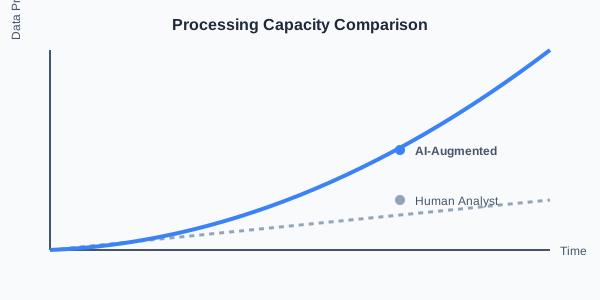
This capability is crucial when dealing with the velocity and variety of modern information. For instance, during a breaking news event, AI can instantly aggregate reports from multiple languages, translate them, and perform sentiment analysis to gauge public reaction. IBM Security explains how AI in security uses these cognitive capabilities to accelerate incident response, allowing defenders to stay ahead of threats. This aligns with the standards set by the Berkeley Protocol on Digital Open Source Investigations, which emphasizes the need for rigorous methodologies in handling digital evidence. The chart below illustrates the dramatic difference in data processing capacity between traditional methods and AI-augmented workflows.
Concrete opportunities and use cases
The practical applications of AI-enhanced OSINT are vast and varied. In the realm of humanitarian aid, organizations like the United Nations are utilizing these tools to monitor crisis situations. By analyzing social media signals and satellite data, they can identify areas most in need of relief after natural disasters, optimizing the deployment of resources. The UN Global Pulse initiative showcases how big data and AI can be harnessed for sustainable development and humanitarian action, providing a lifeline in chaotic environments where traditional information channels may be disrupted.
In the financial sector, the fight against money laundering and terrorist financing has been significantly bolstered by AI. The Financial Action Task Force (FATF) has highlighted how advanced analytics can detect complex networks of illicit transactions that would otherwise fly under the radar. By automating due diligence processes, financial institutions can screen millions of transactions against global watchlists and adverse media with high accuracy. The FATF report on new technologies underscores the potential of these tools to enhance the effectiveness of anti-money laundering (AML) and combating the financing of terrorism (CFT) efforts.
Furthermore, in the domain of cyber threat intelligence, AI is indispensable for tracking state-sponsored actors and disinformation campaigns. Google Cloud’s threat intelligence team (formerly Mandiant) utilizes these capabilities to monitor threat landscapes, identifying coordinated influence operations that seek to manipulate public opinion. By analyzing linguistic patterns and network behaviors, AI can unmask botnets and troll farms that would be invisible to the naked eye.
Structural weaknesses and risks
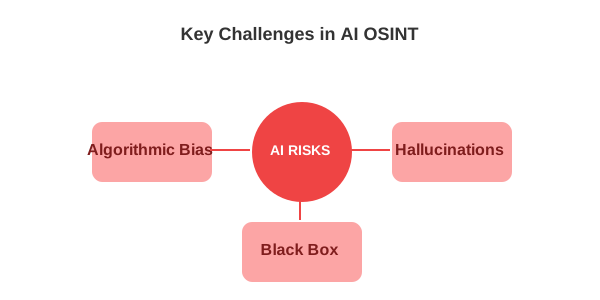
Despite the undeniable benefits, the adoption of AI in OSINT is not without significant risks. One of the most pressing concerns is the “black box” problem, where the decision-making process of complex algorithms is opaque and difficult to interpret. This lack of transparency can undermine trust in intelligence assessments. Furthermore, NIST warns about the dangers of algorithmic bias, where models trained on incomplete or skewed datasets may produce discriminatory or erroneous results. If an AI system is trained primarily on data from a specific region or demographic, its analysis of other areas may be fundamentally flawed.
Another critical issue is the phenomenon of “hallucinations,” particularly with Generative AI models. These systems can confidently present false information as fact, posing a severe threat to the integrity of intelligence products. The OWASP foundation has identified this as a top vulnerability in their Top 10 for Large Language Model Applications. Moreover, there is a risk of human atrophy; as analysts become overly reliant on automated tools, their own critical thinking and investigative skills may degrade. The NIST AI Risk Management Framework provides essential guidelines for identifying and mitigating these risks to ensure safe and trustworthy AI systems.
Beyond internal errors, there is the threat of adversarial attacks. The MITRE Corporation has developed the ATLAS framework to document how adversaries can attack AI systems themselves. Techniques such as data poisoning, where malicious actors inject bad data into a model’s training set to corrupt its behavior, represent a new frontier in information warfare. An OSINT tool that has been subtly manipulated could lead analysts down the wrong path, with potentially catastrophic consequences.
The imperative of governance and augmented intelligence
To navigate these challenges, the future of OSINT must be built on a foundation of “augmented intelligence” rather than full automation. This approach views AI as a partner that enhances human capabilities, not a replacement for them. The human analyst remains the ultimate arbiter, providing the necessary context, ethical judgment, and critical oversight that algorithms lack. Organizations like DARPA are pioneering research into Explainable AI (XAI), aiming to create systems that can explain their reasoning to human users, thereby bridging the trust gap.
Effective governance is also paramount. The European Union has taken a leading role with the EU AI Act, establishing a regulatory framework that categorizes AI systems based on risk. For OSINT practitioners, this means adhering to strict ethical standards and ensuring that the use of AI respects privacy and human rights. As we move forward, the focus must be on continuous training and the development of AI literacy among analysts, ensuring they have the skills to question, verify, and effectively collaborate with their digital counterparts. Only through a balanced approach of innovation and responsibility can we fully unlock the potential of this intelligence revolution.