Rust vs C++: a modern take on performance and safety
The world of systems programming has long been dominated by C++, a language that grants developers unparalleled control over hardware and memory. For over four decades, it has powered everything from operating systems to game engines, trading platforms, and embedded devices. Yet this raw power comes with a steep price: the constant risk of memory leaks, dangling pointers, and undefined behavior that can turn even the most carefully crafted code into a minefield of bugs. Enter Rust, a language designed from the ground up to challenge this paradigm. Rather than relying on developer discipline or runtime garbage collection, Rust enforces memory safety at compile time through its innovative ownership model, promising the performance of C++ without the pitfalls. As major tech companies from Microsoft to Amazon increasingly adopt Rust for critical infrastructure, the question is no longer whether Rust can compete with C++, but rather how these two titans coexist in the modern development landscape.
The tension between these languages reflects a broader shift in software engineering priorities. Where C++ emerged in an era focused primarily on performance and flexibility, Rust represents a generation that has learned hard lessons about the catastrophic costs of security vulnerabilities. The National Vulnerability Database consistently shows that memory safety bugs account for roughly 70% of serious security issues in systems software. Google’s engineering teams have echoed this concern, noting in their security blog that memory safety vulnerabilities remain the most persistent threat to Chrome’s stability. Meanwhile, the Linux kernel developers have begun experimenting with Rust modules, signaling a potential sea change in how foundational software is built. This article examines both languages side by side, exploring where each excels and where compromises must be made.
The memory management battleground
Memory management sits at the heart of the Rust versus C++ debate. In C++, developers wield direct control through manual allocation and deallocation, a double-edged sword that enables fine-grained optimization but demands constant vigilance. The language provides tools like smart pointers (std::unique_ptr and std::shared_ptr) to automate cleanup, yet these remain optional. A single oversight, a forgotten delete or an accidental double-free, can introduce vulnerabilities that persist undetected through testing and code review. The CWE database maintained by MITRE catalogs dozens of distinct memory-related weakness patterns in C++, from buffer overflows to use-after-free conditions, each representing real-world exploits.
Rust’s approach fundamentally reimagines this relationship. Its ownership system establishes three core rules enforced by the compiler: every value has exactly one owner, ownership can be transferred but not duplicated, and when the owner goes out of scope, the value is automatically dropped. This eliminates entire categories of bugs before the program ever runs. Borrowing extends this model, allowing temporary references with strict lifetime guarantees. The compiler tracks every reference, ensuring that mutable and immutable borrows never overlap in ways that could cause data races. What makes this revolutionary is that these safety guarantees come with zero runtime cost, as all checks happen during compilation. The diagram below illustrates the stark contrast in how these languages handle common memory pitfalls.
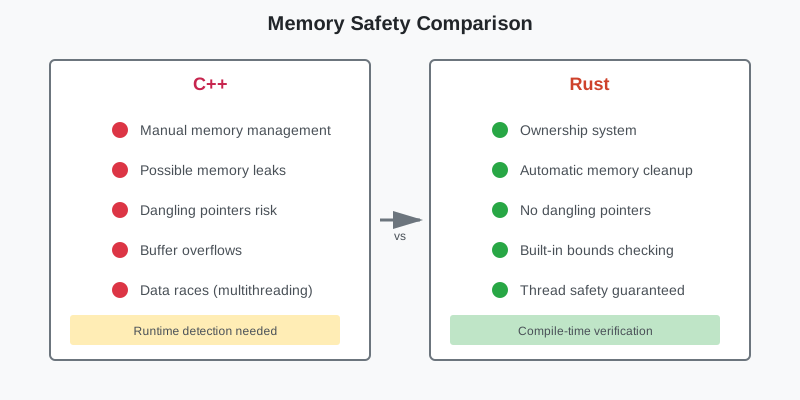
The practical implications are profound. Cloudflare reported in their engineering blog that rewriting performance-critical network components in Rust eliminated an entire class of outage-causing bugs. Their edge servers now handle millions of requests with greater stability, not because Rust is inherently faster, but because the compiler prevents the subtle concurrency issues that plagued their C++ implementation. Similarly, Dropbox documented how adopting Rust for their sync engine reduced crash rates by over 60%, a metric directly tied to Rust’s compile-time guarantees preventing the undefined behavior that had haunted their previous codebase.
Safety guarantees and the cost of freedom
C++ embodies a philosophy of trust: the language assumes you know what you’re doing and stays out of your way. This enables extraordinary feats of optimization, but when things go wrong, the consequences can be catastrophic. Undefined behavior is the dark side of this flexibility. A simple array access beyond bounds, a null pointer dereference, or concurrent writes to shared memory without synchronization can trigger behavior that the C++ standard leaves entirely unspecified. Your program might crash, silently corrupt data, or appear to work perfectly until it fails in production under specific conditions. Tools like Valgrind and AddressSanitizer exist to catch these issues, but they require active deployment and add runtime overhead, meaning they’re often disabled in release builds where bugs matter most.
Rust flips this script. The language operates on the principle that safety should be the default, with unsafe operations requiring explicit opt-in through the unsafe keyword. This doesn’t mean Rust forbids dangerous operations; rather, it quarantines them, making code reviewers immediately aware of where special attention is needed. The type system prevents null pointer dereferences entirely by requiring the use of Option<T>, forcing developers to explicitly handle the possibility of absence. Array accesses include bounds checks by default, with unchecked variants available only in unsafe blocks where performance demands it. As documented by the Rust Foundation, this design has made Rust the language of choice for security-critical applications, from browser engines to cryptographic libraries.
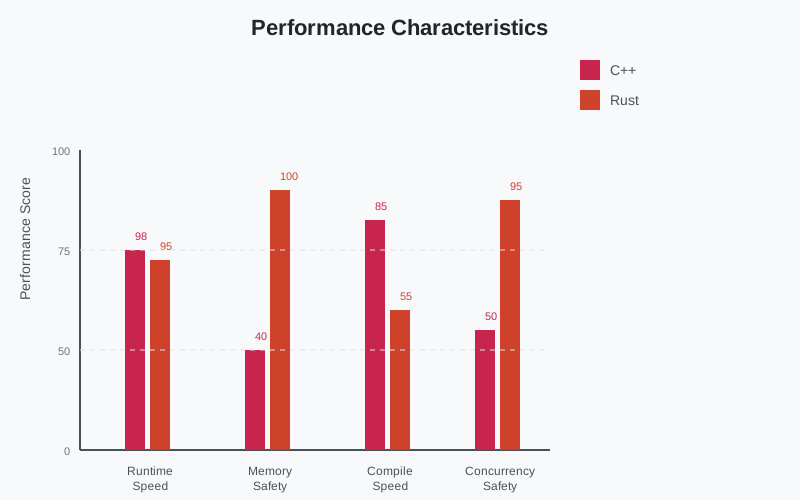
The performance implications deserve scrutiny. Critics argue that Rust’s safety checks impose overhead, particularly bounds checking on arrays. However, modern compilers are remarkably adept at optimizing these away when they can prove access is safe. LLVM, the backend compiler for both Rust and many C++ toolchains, applies identical optimizations to both languages. Benchmarks from the Computer Language Benchmarks Game show that idiomatic Rust often matches or exceeds C++ performance in real-world scenarios. The key difference is that Rust achieves this speed while maintaining guarantees that C++ simply cannot enforce without programmer discipline.
Concurrency and the fearless paradigm
Modern hardware is fundamentally concurrent, with multi-core processors the norm from smartphones to servers. Both Rust and C++ provide threading primitives, but their approaches to safety differ dramatically. In C++, the standard library offers std::thread, mutexes, and atomic operations, powerful tools that nonetheless place the burden of correctness entirely on the developer. Forget to lock a mutex before accessing shared data, or hold multiple locks in inconsistent order, and you’ve created a data race or deadlock that may only manifest under load in production. The language provides no compile-time verification that your synchronization is correct.
Rust’s concurrency story centers on what the community calls fearless concurrency. The same ownership rules that prevent memory safety issues extend seamlessly to thread safety. The type system distinguishes between Send types (safe to transfer between threads) and Sync types (safe to reference from multiple threads). The compiler refuses to compile code that could produce data races, a category of bugs that in C++ often requires sophisticated testing tools to detect. When you need shared mutable state, Rust forces you to use thread-safe wrappers like Arc<Mutex<T>>, making the synchronization explicit and impossible to forget. This doesn’t make concurrent programming easy, but it shifts the difficulty from debugging subtle runtime failures to satisfying the compiler’s requirements upfront.
The Tokio project exemplifies this advantage. This asynchronous runtime enables Rust programs to handle millions of concurrent connections with minimal overhead, powering services at companies like Discord and AWS. The same guarantees that prevent memory bugs ensure that async code cannot accidentally share mutable state across tasks without proper synchronization. In contrast, C++ async programming with libraries like Boost.Asio requires meticulous manual verification that concurrent operations don’t interfere, with mistakes often going unnoticed until they cause production incidents.
The ecosystem and developer experience divide
Choosing a language means choosing its ecosystem. C++ offers a vast, mature landscape built over decades, with libraries for virtually every domain imaginable. OpenGL for graphics, Boost for general utilities, and countless scientific computing frameworks represent deep investments that aren’t easily replicated. The tooling, however, remains fragmented. There’s no standard package manager; developers choose between Conan, vcpkg, or manual dependency management. Build systems range from CMake to Make to Bazel, each with its own learning curve and quirks. This flexibility allows customization but creates friction, especially for teams trying to maintain consistent environments.
Rust takes an opinionated stance. Cargo, the official build tool and package manager, handles compilation, dependency resolution, testing, and documentation generation out of the box. Adding a library means editing Cargo.toml; running tests requires a single command. The crates.io registry hosts tens of thousands of packages with semantic versioning enforced by default. This uniformity accelerates onboarding and reduces configuration bikeshedding. The trade-off is less flexibility, but for most projects, the productivity gains outweigh the constraints.
Compiler error messages tell a revealing story about each language’s philosophy. C++ template errors are notorious for cascading pages of instantiation backtraces that obscure the actual problem. Rust errors, by contrast, are often praised for their clarity, providing not just the error location but suggestions for how to fix it. The compiler acts less like a gatekeeper and more like a patient mentor, guiding developers toward correct code.
Where each language thrives
Despite the hype, Rust isn’t displacing C++ wholesale, nor should it. C++ excels where backwards compatibility and mature ecosystems matter most. AAA game engines like Unreal remain C++ strongholds, with decades of optimized rendering code and extensive tooling that would be prohibitively expensive to rewrite. Legacy systems in finance and telecommunications, where stability and deep integration with existing infrastructure are paramount, will continue running C++ for years to come. The language’s ability to interoperate seamlessly with C makes it indispensable for maintaining and extending vast existing codebases.
Rust is carving out different niches. Web services that demand both performance and reliability, like those built by Figma for real-time collaboration, benefit from Rust’s safety guarantees reducing downtime. Command-line tools written in Rust, such as ripgrep and fd, deliver speeds comparable to their C counterparts while being easier to maintain. Mozilla famously uses Rust in Firefox, with components like the CSS engine rewritten for better security. The language’s growing traction in embedded systems reflects its ability to provide safety even in resource-constrained environments traditionally dominated by C.
Interoperability offers a practical middle ground. Rust’s Foreign Function Interface (FFI) allows calling C and C++ functions directly, enabling gradual migration. A team can rewrite a critical, bug-prone component in Rust while leaving stable legacy code untouched. This hybrid approach lets organizations capture Rust’s benefits without the risk and expense of wholesale rewrites.
The verdict for modern developers
No programming language exists in a vacuum; the “best” choice depends on context. For greenfield projects where safety and long-term maintainability are priorities, Rust presents a compelling case. Its compiler-enforced guarantees mean fewer late-night debugging sessions hunting memory corruption, and its modern tooling reduces friction in the development workflow. For projects embedded in existing C++ ecosystems, or where specific libraries and frameworks have no Rust equivalents, C++ remains the pragmatic choice.
What’s certain is that Rust has permanently altered the conversation around systems programming. It proves that memory safety and zero-cost abstractions can coexist, that fearless concurrency is achievable, and that developer experience matters even in low-level languages. C++ isn’t going away, but its dominance is no longer absolute. The future likely belongs to developers who understand both languages, wielding Rust where safety is critical and C++ where legacy and ecosystem depth demand it. In this evolving landscape, the real winner is software quality, as competition drives both languages to improve and adapt to modern challenges.